


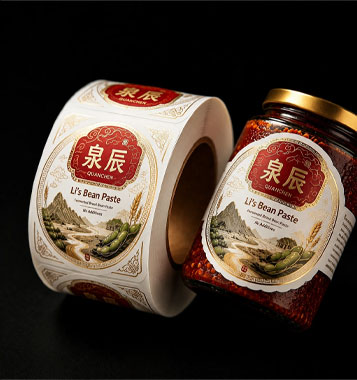
Wine and beverage products face complex and variable terminal display and usage scenarios. Condensed moisture adhesion, prolonged ice bucket soaking, and temperature and humidity fluctuations during warehousing and transportation continuously test the comprehensive quality of bottle labels. Ordinary copperplate self-adhesive labels are prone to wrinkling, color bleeding and edge curling, undermining the premium brand texture. Pearl-Coated Self-Adhesive Labels feature a unique coating structure, stable substrate performance and excellent process adaptability, perfectly meeting the full-scenario usage needs of high-end wine products, making them the preferred packaging material for numerous boutique wine and luxury beverage brands.
1. Comprehensive Performance Test Comparison Between Two Mainstream Wine Label Materials
The quality of wine labels cannot be judged only by visual printing effects. It is essential to conduct tests covering the entire process of transportation, warehousing, terminal display and consumer use. With over 15 years of experience in custom self-adhesive label manufacturing, Shengcai has completed hundreds of groups of tests on ice water immersion, temperature and humidity cycles and process adaptation for high-end wine scenarios. The following table intuitively shows the all-round performance differences between pearl-coated paper and copperplate paper self-adhesive labels.
| Test Dimension | Pearl-Coated Self-Adhesive Labels | Standard Copperplate Self-Adhesive Labels |
|---|---|---|
| Visual Performance | Delicate diffused pearlescent luster with soft layered texture under dim light and refrigerated conditions, perfectly compatible with premium wine label crafts of foil stamping and embossing for outstanding luxury texture | Only two basic reflective effects (matte and glossy) with single visual performance, looking thin and cheap in low-temperature and humid environments |
| Ice Water Immersion Resistance | Remain flat, bubble-free and deformation-free after 1-4 hours of ice water soaking, completely avoiding bottle color bleeding, ideal for iced beverage scenarios | Start wrinkling within 30 minutes of soaking, become translucent after 1 hour, resulting in blurred printed patterns due to dark bottle color penetration |
| Post-Print Craft Compatibility | Dense and tough substrate fibers, supporting deep 3D Embossed Labels, partial foil stamping, holographic foil and partial UV crafts with stable and non-rebounding pattern forming | Loose and soft paper layers, prone to cracking and collapsing during deep embossing; high foil peeling rate and incomplete edges in large-area foil stamping with low qualified rate for complex crafts |
| Environmental Adaptability Stability | Resistant to alternating high and low temperatures, extremely low edge curling rate in humid warehousing environments, suitable for long-term adhesion on curved glass bottles | Poor adhesive stability under fluctuating temperature and humidity, prone to edge curling and debonding after half a month of warehousing with weak weather resistance |
| Brand Premium Shaping Capability | Dual advantages of light texture and three-dimensional touch, easily create luxury glass bottle packaging, strengthen consumers’ high-end cognition and improve product added value | Homogeneous and mass-market appearance, unable to form packaging differentiation from competitors and support high-end product pricing |
2. Core Advantages of Pearl-Coated Self-Adhesive Labels for High-End Wine Scenarios
2.1 Excellent Moisture Resistance Adapts to Core Iced Scenarios
Ice bucket immersion test is a core inspection standard before the mass production of high-end wine labels, and it is also a key factor distinguishing ordinary labels from high-end labels. In fact, the fundamental moisture resistance gap lies in the surface coating structure. Copperplate paper has dense porous surface coating, allowing water vapor to continuously penetrate the paper core and damage the paper structure and printed layers.
Pearl-Coated Self-Adhesive Labels are compounded with exclusive pearlescent barrier coating on the surface to form a dense waterproof protective layer, blocking water penetration from the source. Matched with Shengcai’s customized water-resistant adhesive for glass bottles, the labels remain flat and dry even after long-term immersion in ice water, without color bleeding, blackening or peeling, perfectly adapting to iced consumption scenarios such as banquets and tasting parties.
2.2 Strong Craft Plasticity Creates Differentiated Packaging Texture
With increasingly fierce competition in the wine packaging industry, single flat printing can no longer meet brands’ differentiated needs, and the combination of multiple post-print crafts has become the mainstream choice for high-end wine labels. The final craft effect completely depends on the quality of the label substrate.
The popularity of Embossed Foil Wine Labels in the high-end wine market stems from the superior substrate advantages of pearl-coated paper. It features uniform density and sufficient toughness, presenting clear, crack-free and non-rebounding lines after deep 3D embossing. Combined with foil stamping, holography and UV crafts, it delivers both three-dimensional layering and metallic luster. In contrast, copperplate paper has soft and fragile substrate, resulting in a high defective rate in complex craft processing and difficulty in presenting exquisite high-end visual effects.
2.3 Stable Weather Resistance Adapts to Full-Link Circulation Scenarios
A high-quality wine label must not only adapt to terminal usage scenarios, but also withstand the full-link tests of production, warehousing, transportation and display. Most wine products need to be stored alternately in cold storage and normal-temperature warehouses with frequent temperature and humidity changes.
Pearl-Coated Self-Adhesive Labels undergo special shaping treatment, with far superior thermal stability and moisture resistance than ordinary copperplate paper. They can effectively avoid edge curling, debonding and discoloration caused by temperature and humidity changes, maintain neat and exquisite bottle packaging throughout the process, and reduce packaging loss during product circulation.
3. FAQ for High-End Custom Label Manufacturing
Q1: Why do copperplate paper wine labels turn black after ice water soaking?
Copperplate paper wood fibers expand rapidly and become translucent after absorbing water, and the dark background color of glass bottles penetrates the wet paper, resulting in a black and gray visual effect. Adopting Pearl-Coated Self-Adhesive Labels with high wet strength locks fiber moisture through the surface barrier coating, completely solving the problem of label color bleeding and blackening.
Q2: Will the special texture of pearl-coated paper affect automatic labeling machine operation?
No. The fluency of automatic labeling mainly depends on substrate tension, liner material and adhesive adaptability, rather than surface texture. Shengcai can specially adjust the substrate thickness and tension of Pearl-Coated Self-Adhesive Labels according to customers’ high-speed production line parameters. After calibration, the feeding and fitting accuracy is consistent with ordinary labels without jamming, deviation or missing labeling.
Q3: Is small-batch customization of pearl-coated labels suitable for niche craft wine brands?
It is highly suitable. High-end label customization currently supports flexible order quantities, catering to niche brands and limited-edition products. Brands can customize samples first to test printing effect, ice water resistance and glass bottle labeling adaptability, and start mass production after confirmation, greatly reducing the trial cost of new product packaging.
Q4: Do pearl-coated self-adhesive labels require additional lamination for waterproofing?
No extra lamination is required for conventional scenarios. Standard Pearl-Coated Self-Adhesive Labels come with native waterproof barrier coating, suitable for daily condensation and short-term ice water immersion. For special scenarios with long-term high humidity and continuous ice water soaking, ultra-thin lamination can be added to further enhance durability and service life.
4. Material Selection and Customization Suggestions for High-End Wine Labels
Wine label material selection should not only refer to printing renderings, but also comprehensively consider product positioning, circulation links and terminal usage scenarios. For brands targeting high-end luxury positioning whose products are frequently exposed to ice water and condensed moisture and pursue packaging differentiation advantages,Pearl-Coated Self-Adhesive Labels are the optimal choice.
Shengcai has focused on the R&D and customized production of high-end self-adhesive labels for more than 15 years, equipped with full sets of advanced printing equipment and a complete quality control system. We provide one-stop services including material selection, process design, sample testing and mass production. Customized label solutions are formulated according to customers’ bottle curvature, storage environment and process requirements, avoiding packaging defects from the source and helping brands create high-quality, high-texture bottle packaging.