
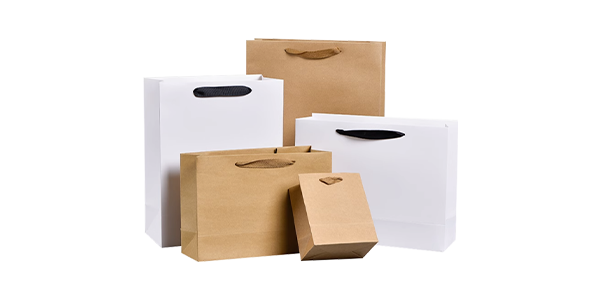
In daily life, paper bags are ubiquitous practical items—whether it’s the handle-equipped bag handed over by shop assistants when shopping for clothes, the handleless bags elderly people use to carry vegetables in the market, or the promotional bags distributed at brand events. At first glance, the difference seems to lie only in “having a handle or not,” but in reality, there are considerable differences in material, purpose, and practicality. Many people default to choosing paper bags with handles, but handleless versions also have irreplaceable scenarios. Today, we will detail the differences between the two to help you accurately select the right style.
| Comparison Dimension | Paper Bags with Handles | Paper Bags Without Handles |
|---|---|---|
| Core Feature | Equipped with handles (cotton rope, hemp rope, plastic rope, etc.) | No additional handles; relies on folded bag openings or material itself for load-bearing |
| Main Material | Kraft paper, white cardboard, coated paper (some paired with non-woven fabric) | Primarily non-woven fabric, with a small amount of thin paper |
| Processing Difficulty | Requires additional punching, threading, and fixing; more complex processes | Direct cutting and forming; simple processing flow |
| Load-Bearing Capacity | Stronger, generally 3-8 kg; suitable for heavier items | Weaker, mostly 1-3 kg; only for light items |
| Reuse Rate | High (70%-85%); handles are sturdy and not easily damaged, allowing multiple uses | Low (less than 10%); bag openings are prone to tearing, mostly for one-time use |
| Cost Level | Slightly higher (includes handle materials and processing fees) | Lower (saves costs related to handles) |
| Promotion Effect | High brand exposure (reuse increases communication frequency) | Temporary promotion only; short communication cycle |
Many people think handleless paper bags are less practical than those with handles, but they are more appropriate in specific scenarios:
The reason why paper bags with handles are more popular lies in their dual advantages of “practicality + communication”:
Q: Are handleless paper bags more environmentally friendly?A: Environmental friendliness mainly depends on the material. Most handleless non-woven bags are made of degradable materials. Bags with handles can also be environmentally friendly if they use paper handles and recyclable paper. The key is to choose degradable materials, not whether there is a handle.
Q: Do the handles of paper bags with handles break easily?A: It depends on the handle material and fixing process. Cotton and hemp ropes are much more durable than plastic ropes. The design of adding reinforcing sheets after punching can also improve durability. You can focus on these two points when customizing.
Q: For small-batch customization, which is more cost-effective: with handles or without?A: For small-batch customization (such as hundreds of pieces), handleless bags have a shorter processing cycle, no need to wait for handle procurement and processing, and the cost difference is more obvious. You can give priority to handleless bags if the budget is limited; if you pursue texture, bags with handles are slightly more expensive but can enhance the brand image.
Whether it’s paper bags with handles or without, there is no absolute advantage or disadvantage. The key is to match your own usage scenarios and needs. By choosing based on loading weight, target audience, promotion needs, and budget, you can make the paper bags both practical and maximize their value.
Driven by e-commerce growth and premium consumption, th […]
In daily life, paper bags are ubiquitous practical item […]
The moment you open a delivery box, a cosmetic package […]
Many consumers have had the experience: a carefully sel […]
Related links:
About us Company News Industry Dynamics Cardboard box Corrugated box Cylindrical box Envelope Gift box Label Paper bag SSL 100% Secure Transactions
